Showing posts with label planning. Show all posts

Friday, 26 November 2010

The view from here

I’ve been running some time management workshops recently and one of the things that we’ve been looking at is the direction in which people are heading, their longer-term goals. Having a direction is an excellent way (and possibly the only real way) of establishing your priorities, without which it’s impossible to organise yourself in any meaningful way. The thinking behind this is that it’s important to know where you want to get to otherwise, as Lewis Carroll pointed out, it doesn’t really matter which way you go.

I left school with weak A-levels and didn’t go to university. A few years ago, I decided that I was going to return to studying and get the degree I didn’t get a quarter of a century ago. As I was thinking about this, it struck me that it would take about six years to do this and that I would be 45 years old by the time I got my degree. That length of time felt daunting until I realised that, unless something dreadful happened, in six years I was going to be 45 anyway – I might as well be 45 with a degree.

My destination was the degree and I had a vague idea of what I was going to do with it when I began studying. An analogy that I often use is that of a pilot filing a flight plan: when the plane takes off, the pilot knows where he’s going to land – unless, of course, something unexpected happens. It’s a helpful analogy but, like any analogy, if you push it too hard it will break down. Since I made my choice, my outlook has changed and evolved. In the words of every contestant on the X-Factor, I’ve been on a journey and the view from where I am now is different to the view I had when I started studying.

Someone once told me that “to decide is to divide” – a yes to one option is automatically a no to another option. But that yes also opens up the possibility of a whole lot of other options. Because of the choice I made five years ago, I was alert to several opportunities that have come my way in the last few weeks, opportunities that have helped to clarify that vision I mentioned above. For us, the destination doesn’t have to be fixed in stone – we’re not locked into a flight plan and it’s possible for us to change our destination at any point. It’s what makes the journey exciting.

Thursday, 13 May 2010

Speed

Like many people, I’ve been keeping an eye on the television over the past few days, keeping up with the ongoing political situation here in the UK. The thing that’s struck me most is the number of presenters who have been camped out in all weathers, reporting from outside various locations, waiting for something to happen. Exactly why it was necessary to drag these presenters blinking into the sunlight from their warm and cosy studios, I’m not entirely sure but I suspect it has a lot to do with our culture’s current obsession with speed.

Aside from giving the spurious impression that the news they are conveying is somehow more accurate because they are “on the scene”, the main reason for having presenters in Downing Street or outside the cabinet offices is so that they can capture events, as they happen. Sky, for one, makes great play of being the first to bring what is now referred to as “breaking” news as does BBC Radio 5 Live.

But what does speed give us? In all but a very few instances, speed or immediacy adds little: it tells us what has happened but the focus on immediacy means we don’t understand why it happened, or the consequences of what has happened. It’s symptomatic of our broader desire now to get things done quickly. Mobile phones are with us all the time and we’re expected to be available almost 24 hours a day. Email is all but instantaneous so some people assume that the reply should be, too, and I’ve written before about the pressure for ever increasing efficiency – for which, again, read speed.

Where in all of this instant reaction is the opportunity to stop and think? Where is the opportunity to consider, to reflect, to weigh up alternatives? How many mistakes might be avoided, how many ideas might be improved, how many decisions might be better, simply by avoiding this pressure and slowing down? I’ve spent this week with a great bunch of people, all of whom report being under so much pressure that they are at near breaking point. It’s not that they’re inefficient, or poor at their jobs, or unintelligent – they’re just struggling to keep up with the relentless pace of the jobs they do. The only way they stand any chance of keeping up is to react instantly, constantly spending time in Quadrant One, slowly but surely burning out.

It takes courage to take a stand against this tide and I hope, during the course of this week, I was able to give them something that might help. It’s a situation that I’m facing with delegates more and more often, though, and seems to be a trend which is only going one way. It’s like we’re all speeding along a motorway: we’re unsure of where we are or where we’re going, certain only that we’re making such good progress we don’t have time to check the map.

Thursday, 8 April 2010

If things don't change...

Many years ago, I came across a Tibetan saying: “if you want to know your future, look at what you are doing in this moment.” At the time, I didn’t fully understand what it meant but over the years it’s come to be an important saying to me because it has two meanings.

Firstly, it reminds me of that other old saw – if things don’t change, they’ll stay the same. Whatever we’re doing now, we’ll still be doing it in ten years unless something intervenes to change it. Often, we rely on circumstances or external factors to change what we’re doing – we complain about a job that makes us unhappy but don’t take the steps to improve it or leave, preferring instead to hope that something – redundancy, retirement, a lottery win – will intervene to change things.

Of course, more often than not, those things don’t happen and so time drifts by and we find our selves fundamentally living the same life we lived ten years previously. It’s only then we realise that “if things don’t change, they’ll stay the same” isn’t the entire truth: that only holds true if the rest of the world is static, too. It’s more accurate to say that if things don’t change they’ll steadily decline – but that’s quite depressing and doesn’t have quite the same ring to it.

The second meaning for my Tibetan phrase is the one that really resonates with me. Whatever your life is like in this moment, the chances are that the shape of your life has its roots in your past – often quite some way in your past. We plant seeds every day and they grow slowly – sometimes we do not even know that we are planting them but they bear fruit in our lives nonetheless. We are often too casual about this – not paying attention to the seeds we’re planting, only to have them blossom into a harvest that we really don’t want.

It’s truly the case that we reap what we sow in life. Each day, consciously or unconsciously, we are shaping our future and we must pay attention to the seeds we’re planting. This week, as you go about your life, focus on what you are doing in each moment; for every activity, think carefully about how it will shape your future – because it surely will.

Friday, 12 March 2010

A game of inches

There’s great excitement at the inspired offices because this weekend marks the start of the new season for both Formula 1 and the IRL (F1’s American equivalent). Before you switch off, thinking that this entry is going to be petrol-head heaven, it struck me as I watched the F1 practice session this morning that there are a lot of good business lessons to learn from the physics of motor racing.

It takes about five months to design and build a Formula 1 car and the costs run into the millions, per car – even the wheel nuts have to be specially designed and built and cost in the range of £300 each! Many clever people work long and hard on the aerodynamics of the car, finding the most efficient shape that allows the car to move cleanly through the air; they work on the engine, finding ways of squeezing the maximum speed from it; they work on the tyres, finding exactly the right formula for the rubber. The driver himself (or herself, in the case of IRL) trains hard in order to improve his/her reaction times and ability to cope with the huge g-forces they experience.

All of that time, effort and money relies just one thing; that tiny area of the tyres which is touching the track at any given moment. Called the contact patch, all of those untold millions of pounds, dollars and hours rest on an area roughly equivalent to an A5 sized piece of paper. Introduce anything into that contact patch between the tyre and the track – water, gravel, bits of worn rubber – and all that time, effort and money will count for nothing. The most powerful engine in the world won’t be able to move the car if the tyres can’t convert that energy to forward motion.

So what’s the relevance to business, you ask? How many times have you been on a workshop and had time at the end to do some action planning? So often, I’ve seen delegates just take it as an opportunity to call a taxi, arrange their bags, pack up their stuff, have a cup of coffee or an extra break – anything, in fact, except what they’ve been asked to do: their action planning. And yet that little action planning session is the most important part of the day, the equivalent of the contact patch – the whole value of the workshop rests on that session, where you work out how best you can convert what you’ve learned into new behaviour at work. And that’s really the point, isn’t it? The purpose of learning is not knowledge – it’s action.

I once heard someone describe yacht racing as a game of inches. I suspect that’s the same for all sports and for business, too – the tiniest of things can make the biggest difference. Most people don’t recognise the importance of those tiny things but the best sportsmen/women and businessmen/women do. That tiny session, that brief period of time when the trainer asks you to do some action planning, is one of those moments – use it wisely.


Friday, 26 February 2010

Just one thing

Over the last couple of months, we’ve looked at daily and weekly planning, the key steps towards achieving increased productivity and balance. This week, we’ll finish the series by outlining the process of weekly planning.

The key benefit of weekly planning is that it gives you the chance to stop and think – to step back from the day-to-day and take a broader view. This can feel difficult when all of those urgent issues and tasks are pressing in on you but the busier you are, the more important weekly planning is. It only takes fifteen minutes or so and you can make it a regular part of your routine – essentially, a habit – by scheduling it into your diary as a weekly meeting with yourself.

The first step is to review your roles. Some of your roles will change as you go through life while other roles will stay with you for longer periods or even last a lifetime. Take a moment to reconnect with those roles, ensure they’re still relevant, and remind yourself of what you’re trying to achieve in these roles.

Secondly, ask yourself, what is the most important thing I could do in this role this week? Not everything you could do; not everything you have to do; not everything you hope to do. Just the most important thing – the one thing that would make all the difference. Of course, you'll do other things in those roles but what you’re looking for at this point is simply the most important thing.

The third step is then to schedule it into your week: if it’s an appointment, put it into your calendar, if it’s a task, put it onto your daily task list for the relevant day. When that day comes, that task is the most important thing you have to do that day – it’s your top priority. This is so important: it means that, whatever else happens that week, no matter what other urgent or unexpected activities come crashing into your schedule, you’ll have done some significant, longer-term, activity – something that takes you one step closer to achieving your goals.

You will have noticed that none of the steps to weekly or daily planning are what you might call rocket science and that’s a good thing. Complexity, in this case, is unnecessary – simple things, done well and repeatedly, will produce much more significant results in the longer term. But don’t take my word for it – try it for yourself and prove it.

Friday, 19 February 2010

What would you do with a 25th hour?

Last week we looked at the first part of weekly planning – establishing your roles in life. This week, I want to think a little more about why that’s important and what weekly planning will give you that you don’t have now.

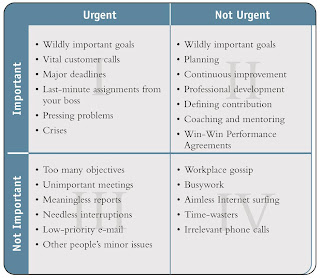
In his bestselling book, “The 7 Habits of Highly Effective People”, Stephen Covey talks about the Time Matrix – a four-box model allowing tasks to be categorised based on whether they are important and/or urgent. It’s not a new model – the first reference I’ve found to it is as the Eisenhower method, as it was said to be used by the US President, although it’s not clear whether that’s apocryphal or not.

© FranklinCovey

When I run Time Management workshops, I’ll very often ask people what they would do if they had a 25th hour – you can think about this question, too. As I’m psychic, I know you’re thinking that you would spend that hour sleeping so I’ll let you do that for a couple of weeks and then you have to do something else: you can do anything you want. Inevitably, the things people come up with are Quadrant II activities; they say they would spend time with their loved ones, play with their kids, learn a language or a musical instrument, travel, paint or simply sit and read a book. You probably came up with something similar.

Why do they never get round to doing these things; why do they need a 25th hour? Because most people spend most of their time in Quadrants I and III. By definition, Quadrant II activities aren’t urgent and there are always other, urgent things to do which take priority – even when those urgent things aren’t important. The Quadrant II activities are left for those times when you have less to do; when things aren’t so crazy around here; when things calm down a bit.

It doesn’t have to be that way. What weekly planning gives you is the opportunity to schedule in some of those Quadrant II activities. And because the most important things in our lives tend to revolve around relationships – with ourselves and with others - establishing your roles in life is more than just categorising what you do. It also means thinking about how you do it. Decide what kind of bricklayer or musician you want to be and then schedule activities to help you achieve that.

The great benefit of weekly planning is that it changes your focus, lifting you out of the day-to-day grind of the urgent and into the future. We all have dreams, hopes or aspirations – they may be big or small but they are all important and should never be put off while we deal with things that are, fundamentally, unimportant. As Goethe said, “things that matter most must never be at the mercy of things that matter least.

Friday, 12 February 2010

Planning weekly, not weakly...

When we last talked about time management, we talked about daily planning and while the format, degree or rigour of planning varies, many of you already take time to make some kind of plan for the day. However, very few people also plan on a weekly basis, which is one of those instances where we just make things harder for ourselves. Planning daily but not also weekly inevitably means that our focus will always be on the short term. By definition, we’re only thinking about the things that have to be done today. Weekly planning is a simple way of allowing ourselves the opportunity to schedule in those things that are important but aren’t urgent – they have to be done sometime, but not necessarily today and so inevitably they’re put off. If you’re looking for that elusive work/life balance, you’ll find it in weekly planning

Weekly planning only takes about fifteen to twenty minutes each week – I do mine on a Friday morning at 10 o’clock because I’ve found that’s what works best for me. You can do it whenever you prefer but my advice would be to avoid Monday mornings (it’s too late – the week has started) and Friday afternoons (things mysteriously seem to be sacrificed on Friday afternoons). Ideally, you should do it at the same time every week, so that it becomes a regular appointment with yourself.

Before we get to the step-by-step process, you’ll firstly need to understand what your roles are in life. The easiest way of doing this is to think about all the things you do on a weekly basis and categorise them. If you spend a lot of time laying bricks each week, it’s safe to say you’re a bricklayer for at least part of the time. If you spend time playing a musical instrument, you’re a musician for part of the week. For instance, over the course of the week I’m a facilitator, a parent, a friend and a student, to name just four.

If you want to improve your time management skills, take some time over the next few days to identify no more than seven roles that cover everything you do over the average week. If you come up with nine, merge a couple so that you bring the total down to seven but if you only come up with six roles, don’t make one up. There’s nothing magical about the number seven, it’s just a realistic number of roles on which you can focus. These roles aren’t fixed in concrete – some will change as your circumstances change – but understanding your roles is key to your weekly planning and establishing some balance and control in your life.

Friday, 15 January 2010

The crucial one percent

I ended last week’s blog by teasing you with The Most Important Question You’ll Ever Ask Yourself and I’ll come back to it in a minute, I promise. But first, I want to make it clear that if you’re serious about getting more done this year, you’re going to need to adopt the discipline of regular planning.

Discipline sometimes has a bad reputation but it’s discipline that allows us to do… well, pretty much anything. You won’t have the freedom to play a musical instrument unless you had the discipline to practice. You won’t have the freedom to compete as an athlete unless you had the discipline to train. You won’t have the freedom to achieve your goals if you don’t have the discipline to plan them out. This means planning each week and each day and it’s daily planning that we’re looking at now.

It will only take you five minutes, at most - that’s taking less than 1% of your day to ensure that the other 99% is well spent. It involves checking your Master Task List, deciding which of those tasks you can reasonably expect to do today, and then transferring them from your Master Task List to your To Do list.

The length of your To Do list depends on your answer to The Most Important Question You’ll Ever Ask Yourself, which is, how long do I want to work today. It’s a simple but powerful question and if the answer, every day, is “about 30 minutes”, do yourself a favour and get another job! Most people find they have enough work to keep themselves going 24 hours a day – you don’t want to work that long, so asking this question determines the number of hours you have available to spend on tasks. From that number, you subtract any meetings or travelling that you have to do. Whatever number is left, halve it and then that lower number is the number of hours' worth of tasks that you put on your To Do List.

Why halve the number? It’s common sense, really: the unexpected happens every day and we need to build flexibility into our plan to accommodate it. The primary reason why people fail at planning is they fill every available minute and don’t take account of what Donald Rumsfeld called “the known unknowns” – the stuff we know will happen, we just don’t know when: the emails, phone calls, chats with colleagues, trips to the loo and so on that stop us actually working.

Trying to plan each day from your Master Task List without a To Do list can be overwhelming; faced with an endless list of tasks that never seems to shrink, it’s easy to get discouraged. Using a shorter To Do list will give you a sense of perspective and progress and using some common sense ensures you won’t get overloaded. But how do you ensure that you’re staying on track? For that, you’ll have to come back next week when we look at weekly planning.

Friday, 8 January 2010

To do, doing, done...

Following my previous post, the snow over the last week has prevented me from leaving the house very often and I’ve been able to devote a bit of time to looking at the “how” part of managing your time. Over the next couple of weeks I’ll develop this further and provide you with some useful tips for organising yourself in the New Year, as well as helping you overcome common time management pitfalls.

Whatever system you use – Blackberry, iPhone, Filofax, DayPlanner or any of the hundreds of other, similar, systems – it should do four things for you. It should tell you where you need to be (a calendar); who you need to be there with (a contacts list); what you need to do when you’re there (a task list) and remind you what you did afterwards (a place to keep notes). Those four things don’t all have to be in the same place; for instance, I keep my calendar, contacts and task list on my Blackberry, because I find it convenient and it’s portable, which is important given the amount of travelling I do. However, taking notes on the Blackberry is inconvenient, so I use a Moleskine journal for that.

You could have four separate places for those four things – whatever works best for you. The important thing, however, is to only have one place for each of them. For instance, one place for notes, one place for appointments and so on. It often happens that people try to keep multiple calendars going – one for work, one for home, one on the fridge door for the kids and so on. I’m not saying that can’t work – clearly it does for some people – but it involves an awful lot of duplication and immediately invites the possibility that you’ll update one calendar and forget to update the others. Almost inevitably, things fall through the “cracks” between the calendars. If you haven’t already noticed this, I’m a simple man and I like to keep things simple so my advice is to have one place and one place only.

There is an exception to this, however, and that’s your task list. So often, people only run one, ever-increasing task list – it gets longer and longer every day as they add new tasks to it. Stress comes from work you haven’t done, not work you have, and using one task list constantly reminds you that each time tick anything off, there’s still far more to be done. So, when it comes to tasks, one of the smartest things you can do to help improve your productivity is to keep two lists. While this might sound counter-intuitive, it will work in your favour and dramatically increase both your feeling of productivity and your actual productivity.

The first list is your Master Task List: this is the “dumping ground” for all of the things you need to do. Something occurs to you, someone asks you to do something – add it to your Master Task List. This Master Task List can be as long as you like, although I recommend that you review it on a monthly basis. The second, smaller, list is your “To Do” list. You prepare this every day (don’t worry, it’ll only take you a couple of minutes) and it is a sub-set of your Master Task List. Your To Do list should contain only the things you can reasonably expect to do that day, no more and no less. The length of that list is determined by the most important, most life-changing question you will ever ask yourself – and I’ll tell you what that question is next week.

Thursday, 29 October 2009

It's not a bad plan...

I was working with a group recently and I asked why it is that some work or task starts as not being urgent but eventually becomes urgent because it’s left; the answer they gave me, as groups often do, is that bad planning caused it. Now, bad planning can be the cause of many problems in business – and in life generally – but planning is not the panacea it is often thought to be. There is much more to achieving a goal than just having a plan.

Think of a city, separated from lush farmland by a deep chasm. The inhabitants of the city gaze across the chasm and begin to ask themselves what it would be like to be able to use that farmland – to grow more food, perhaps different food. They get excited about the prospect of being able to expand out, even beyond the farmland and so they commission the city’s architect to design a bridge and when the design is complete they task the city’s builder with constructing it. Soon, the bridge is finished and the inhabitants of the city are crossing back and forth, happily using the produce of the new farmland to enhance their lives.

In a nutshell, this story describes the four stages of goal achievement – and the broader process of project management. After all, what is a goal if not a mini project?

Initiate

The first phase is to have the vision of what you want to achieve – in this case, spanning the chasm and using the farmland that’s currently just out of reach. In projects, this is where you get very clear about your end result, about what your stakeholders and key stakeholders want, about your criteria for success.

Plan

Having decided where you want to go, you have to work out how to get there – the architect’s blueprint for the bridge. In projects, this is where you set out clearly and logically how you will get from where you are now to the vision outlined in the Initiate phase. The plan can be for a beautiful and ornate bridge or a strict, utilitarian bridge – whatever your key stakeholders define for you as part of their vision.

Act

However, having a vision and a plan are vital but insufficient. You can have a great plan but it will be worthless if you don’t do anything with it. This stage is where we take action. We execute the plan – either building the bridge or working through our project plan, responding to events, reviewing our progress, adjusting where necessary, sticking with it

Complete

The hallmark of a project is that it must finish; goals are there to be achieved – at some point, you complete the bridge, you reach the end of the plan, the other side of the chasm. Here is where we learn the lessons from our project and assess the benefits of having completed it – did achieving the vision bring us all we hoped it would, what’s our vision for the future, how do we apply the lessons to our next project?

All four parts are essential to make up the project or the goal – failing to carry out any one of them will dramatically lessen your chances of success, now and in the future. Planning is important but it’s not enough: without a vision, a plan is vague and unfocussed; without action, a plan is just a useless piece of paper; without completion, we’re doomed to repeat the mistakes of our previous plans.