Friday, 26 February 2010

Just one thing

Over the last couple of months, we’ve looked at daily and weekly planning, the key steps towards achieving increased productivity and balance. This week, we’ll finish the series by outlining the process of weekly planning.

The key benefit of weekly planning is that it gives you the chance to stop and think – to step back from the day-to-day and take a broader view. This can feel difficult when all of those urgent issues and tasks are pressing in on you but the busier you are, the more important weekly planning is. It only takes fifteen minutes or so and you can make it a regular part of your routine – essentially, a habit – by scheduling it into your diary as a weekly meeting with yourself.

The first step is to review your roles. Some of your roles will change as you go through life while other roles will stay with you for longer periods or even last a lifetime. Take a moment to reconnect with those roles, ensure they’re still relevant, and remind yourself of what you’re trying to achieve in these roles.

Secondly, ask yourself, what is the most important thing I could do in this role this week? Not everything you could do; not everything you have to do; not everything you hope to do. Just the most important thing – the one thing that would make all the difference. Of course, you'll do other things in those roles but what you’re looking for at this point is simply the most important thing.

The third step is then to schedule it into your week: if it’s an appointment, put it into your calendar, if it’s a task, put it onto your daily task list for the relevant day. When that day comes, that task is the most important thing you have to do that day – it’s your top priority. This is so important: it means that, whatever else happens that week, no matter what other urgent or unexpected activities come crashing into your schedule, you’ll have done some significant, longer-term, activity – something that takes you one step closer to achieving your goals.

You will have noticed that none of the steps to weekly or daily planning are what you might call rocket science and that’s a good thing. Complexity, in this case, is unnecessary – simple things, done well and repeatedly, will produce much more significant results in the longer term. But don’t take my word for it – try it for yourself and prove it.

Friday, 19 February 2010

What would you do with a 25th hour?

Last week we looked at the first part of weekly planning – establishing your roles in life. This week, I want to think a little more about why that’s important and what weekly planning will give you that you don’t have now.

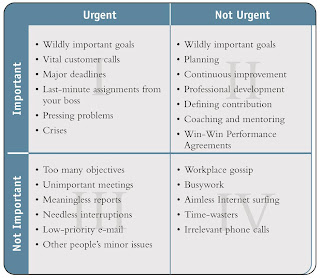
In his bestselling book, “The 7 Habits of Highly Effective People”, Stephen Covey talks about the Time Matrix – a four-box model allowing tasks to be categorised based on whether they are important and/or urgent. It’s not a new model – the first reference I’ve found to it is as the Eisenhower method, as it was said to be used by the US President, although it’s not clear whether that’s apocryphal or not.

© FranklinCovey

When I run Time Management workshops, I’ll very often ask people what they would do if they had a 25th hour – you can think about this question, too. As I’m psychic, I know you’re thinking that you would spend that hour sleeping so I’ll let you do that for a couple of weeks and then you have to do something else: you can do anything you want. Inevitably, the things people come up with are Quadrant II activities; they say they would spend time with their loved ones, play with their kids, learn a language or a musical instrument, travel, paint or simply sit and read a book. You probably came up with something similar.

Why do they never get round to doing these things; why do they need a 25th hour? Because most people spend most of their time in Quadrants I and III. By definition, Quadrant II activities aren’t urgent and there are always other, urgent things to do which take priority – even when those urgent things aren’t important. The Quadrant II activities are left for those times when you have less to do; when things aren’t so crazy around here; when things calm down a bit.

It doesn’t have to be that way. What weekly planning gives you is the opportunity to schedule in some of those Quadrant II activities. And because the most important things in our lives tend to revolve around relationships – with ourselves and with others - establishing your roles in life is more than just categorising what you do. It also means thinking about how you do it. Decide what kind of bricklayer or musician you want to be and then schedule activities to help you achieve that.

The great benefit of weekly planning is that it changes your focus, lifting you out of the day-to-day grind of the urgent and into the future. We all have dreams, hopes or aspirations – they may be big or small but they are all important and should never be put off while we deal with things that are, fundamentally, unimportant. As Goethe said, “things that matter most must never be at the mercy of things that matter least.

Friday, 12 February 2010

Planning weekly, not weakly...

When we last talked about time management, we talked about daily planning and while the format, degree or rigour of planning varies, many of you already take time to make some kind of plan for the day. However, very few people also plan on a weekly basis, which is one of those instances where we just make things harder for ourselves. Planning daily but not also weekly inevitably means that our focus will always be on the short term. By definition, we’re only thinking about the things that have to be done today. Weekly planning is a simple way of allowing ourselves the opportunity to schedule in those things that are important but aren’t urgent – they have to be done sometime, but not necessarily today and so inevitably they’re put off. If you’re looking for that elusive work/life balance, you’ll find it in weekly planning

Weekly planning only takes about fifteen to twenty minutes each week – I do mine on a Friday morning at 10 o’clock because I’ve found that’s what works best for me. You can do it whenever you prefer but my advice would be to avoid Monday mornings (it’s too late – the week has started) and Friday afternoons (things mysteriously seem to be sacrificed on Friday afternoons). Ideally, you should do it at the same time every week, so that it becomes a regular appointment with yourself.

Before we get to the step-by-step process, you’ll firstly need to understand what your roles are in life. The easiest way of doing this is to think about all the things you do on a weekly basis and categorise them. If you spend a lot of time laying bricks each week, it’s safe to say you’re a bricklayer for at least part of the time. If you spend time playing a musical instrument, you’re a musician for part of the week. For instance, over the course of the week I’m a facilitator, a parent, a friend and a student, to name just four.

If you want to improve your time management skills, take some time over the next few days to identify no more than seven roles that cover everything you do over the average week. If you come up with nine, merge a couple so that you bring the total down to seven but if you only come up with six roles, don’t make one up. There’s nothing magical about the number seven, it’s just a realistic number of roles on which you can focus. These roles aren’t fixed in concrete – some will change as your circumstances change – but understanding your roles is key to your weekly planning and establishing some balance and control in your life.

Thursday, 28 January 2010

How to get started when you really don't want to...

I’ve been meaning to write this post for ages but something else always seemed to crop up. First, I had to tidy my desk – you know how difficult it is to write with an untidy desk. Then I noticed there were some old documents I needed to delete from my folders, which then meant that I needed to organise the remaining documents. By that time, some emails had arrived and when I’d sorted those it was time to put some washing on. While I was in the kitchen, I thought I’d make myself a cup of coffee but I found I was out of coffee so I had to go to the shop…

You know the story. There’s a task that you need to do – you may even want to do it. It’s been sitting there for a while now but you never quite seem to get around to it. Consciously or subconsciously, you keep putting it off. But why? And how do you overcome that procrastination?

Not all procrastination is bad but it becomes an unhelpful habit when it starts to put you under pressure or means you risk missing important deadlines. If you find yourself doing this, the key thing is to ask yourself why you’re procrastinating. Is it a difficult or unpleasant task? Do you lack the skills, knowledge or confidence to do it?

If you procrastinate a lot, keep a note each time it happens and look for themes. Some common reasons why people procrastinate are a desire for perfection or a need to know everything before they start a task or a fear of failure. Understanding why you’re putting something off is a key step in spotting future tasks over which you might procrastinate; understanding the beliefs that lead you to procrastinate is the first step to changing those beliefs.

In the short term, here are some quick fixes that will help you to get going:

  • If you can, try doing the hardest or least desirable part of the task first – after that, the rest will seem easy.
  • Break the task down into sub tasks – the more the merrier. You’re more likely to do smaller, quicker tasks and it’s the old joke about eating an elephant: one piece at a time.
  • Get a little egg timer and set it for around ten minutes – don’t check too closely, otherwise you’ll be tempted to clock-watch. Then start the task you’ve been putting off but promise yourself you’ll only do it until the alarm goes off. When it does, you have permission to go and do something more fun – or, if you feel like it, you can reset the alarm and keep on with the task.
  • Reward yourself; promise yourself that when you’ve done the task you’ll go for a walk, or eat a bar of chocolate or book a flight to Hong Kong – then follow through.
  • Hold yourself accountable – or, better still, find someone else to hold you accountable. Tell someone you trust that you’re going to do the task by a particular deadline and ask them to check up on you. With luck, they’ll not only check that you’ve done it when the deadline arrives, they’ll check that you’re working on it in advance of the deadline.

Finally, something that always works for me is to get those unpleasant or unattractive tasks out of the way first thing in the morning. I know I’m at my best in the morning and, if I do it first thing, it’s not hanging over me for the rest of the day.

The inspiredblog is taking a short break next week but we’ll be back on 11 February, picking up on our series about time management and bringing you the secrets of work/life balance. Now – stop reading this and get on with whatever it is you’ve been putting off!

Wednesday, 27 January 2010

Engaging

Those of you who are regular readers will know that we here at inspired have been working on an Employee Engagement workshop over the last six months or so. We ran our first batch of workshops last year and they were very well received - there's a new round beginning soon and you can find details here. If you know someone who might be interested, please do forward the link on.

As well as the MacLeod Report, on which the "Engaging for Success" workshop was based, the CIPD have recently conducted their own survey into employee engagement and you can download it here. I was particularly struck by their assertion that "the extent to which employees find meaning in their work has a substantial impact on how they feel about their working life in general. Employees who believe that their work is important and that they can make a difference have much more positive perceptions about their work and their work environment."

I've talked about this a number of times, in particular in this post, and it's great to have it reconfirmed. I feel strongly about the subject and it almost feels like there's some momentum building. Perhaps this will be the year when employers move away from the old-fashioned industrial-age model of management and begin to truly engage with their workers.

Friday, 22 January 2010

A sticky situation

You find me in a grumpy mood this week. I had planned to post a piece on weekly planning but my eye was caught by a joint paper from Toronto and Chicago Universities, reported in the Economist. It seems that researchers at the universities worked with the managers of an electronics factory in China, to explore the ways in which bonus schemes might be made more effective. If you’re a regular reader of the blog, you’ll know that I’ve had a couple of things to say in the past on the way in which managers and leaders attempt to motivate their teams. It’s a particular interest of mine and what I read did nothing to improve my mood on the subject.

You can find the whole of the report from the Economist here but let me quote a couple of lines which, I feel, sum up the tone of the article and – if we assume the Economist to be reporting faithfully – the paper itself: “the fear of loss was a better motivator than the prospect of gain... Carrots... may work better if they can somehow be made to look like sticks.

Let’s ignore the fact that this research paper is, in essence, a bulletin from the school of the bleedin’ obvious. Researchers find that workers are afraid of losing money they’ve been promised; who could have guessed it? Without wishing to be too political, let’s also overlook the fact that this research took place in China – not a haven of best management practice or the freedom of workers to withhold their labour and search for other employment. Instead, think for a moment about what this paper means and what it suggests. Are we honestly saying, as we enter the second decade of the 21st century, that it is acceptable working practice to threaten people in order to “motivate” them? At a time when workplace stress is increasing (and, interestingly, Chinese workers are the most stressed of all), do we really want to work in environments where that kind of management practice is even considered, never mind actually practiced?

I believe that, fundamentally, people come to work in order to do a good job. I believe that people will do a better job if they know their work has meaning. I believe that one of the roles of managers/leaders is to create the circumstances within which workers can do a good job and then, essentially, get out of the way. It always depresses me when I find there are still managers who think that threats, fear, bullying and intimidation are effective ways of “motivating” workers: the fact that this academic report adds a spurious veneer of legitimacy to that viewpoint just makes me angry.

Sunday, 17 January 2010

How does it feel?

A few years ago, I went through a period of feeling particularly fed up. Not depressed, as such, but what Alan Partridge would described as “clinically fed up”. So I decided to try an experiment that I’d seen somewhere on my travels across the internet.

Each night, when I went to bed, I would pause and think of three good things that had happened to me that day. They didn’t have to be major things – anything that I had enjoyed or which made me feel good, I wrote them down in a little book. It wasn’t a very invasive exercise and only took a minute, literally, each day.

At first, I found it difficult to think of three things – the third one (and sometimes the second one) would feel forced or not significant enough. I’d think of a bag of crisps I’d enjoyed at lunch, or a joke someone had told me and it felt like I was almost making stuff up just to get to three items. However, I persevered and eventually the three things would come to me quite easily.

But then it started to get difficult again. Only this time, instead of struggling to get to three things, I was struggling to keep the list down to three. I started to find that I was sorting and sifting the things that had happened to me, rejecting some of them as not being good enough to make the top three things for that day.

It taught me a valuable lesson. The good things didn’t start happening to me just because I decided to keep a list of them – they were happening all the time but I just wasn’t paying attention to them. Keeping that diary refocused my attention on the good things, rather than the bad things, and brought me out of a low period in my life.

Today, apparently, is “Blue Monday” – you can find more details here. How many people will pay attention to the random bad things that happen to them today simply because they’ve been told that today is the most depressing day of the year? Rather than just accepting that today is going to be a bad day, perhaps today might be a good day to pay particular attention to the good things that happen…